
Vision Aero is an aerospace company based in China, founded by industry veterans and university experts. They specialize in the development of electric vertical takeoff and landing (eVTOL) aircraft such as Vector 5, which is designed specifically to serve emergency medical services. Vision Aero focuses on delivering an efficient and clean next-generation air transportation system.
The Spark Behind the Fire

Wei He, also known as Peter He, still remembers the moment aviation became real to him.
He was seventeen, driving near an airport, when a simple sign caught his eye: “Learn to Fly.” On impulse, he turned in. The first aircraft he noticed was a small propeller plane—exciting, but also intimidating. Safety questions flashed through his mind. Then he looked past it and saw a line of business jets. Beyond those, commercial airliners. In that instant, the industry stopped feeling like a single leap and started to look like a ladder—general aviation, business aviation, and commercial aviation—each rung reachable if one earned the skills to climb. That day didn’t just spark curiosity; it set a direction that would eventually lead him to begin flight training in the United States.
Training didn’t dilute the dream—it sharpened it. He discovered he had a natural feel for flying, and one memory stayed with him: his first solo. The horizon rose slowly in front of the cockpit, the ground noise fell away, and everything condensed into focus and control. It was clarity—pure and demanding—and it left a mark.
Within about a year of earning his private pilot license, he collected the next credentials—commercial, instrument, and CFI—then stepped into flight training as an instructor. But what truly shaped him wasn’t just time in the air; it was what he saw on the ground. The flight school’s utilization was low, operations were inefficient, and the business leaked value through poor scheduling, loose dispatch discipline, and weak continued airworthiness processes. So he rebuilt the operating model—tightened procedures, optimized workflows, and made the organization run like aviation is supposed to run: disciplined, repeatable, and auditable. Utilization rose, and for the first time, he produced meaningful profit from an aviation operation.
From there, his path widened into aircraft trading—moving from small piston aircraft to business jets—where numbers mattered as much as instincts. He leaned into data monitoring and analysis, using modeling to understand margins, demand, and which platforms were likely to outperform. That data-driven mindset later became the foundation for defining Vision Aero’s product lineup.
The Philosophy: No Hype—Only What Can Be Proven
The two experiences of Peter that shaped Vision Aero’s core philosophy are as follows.
First, flight training taught him a truth aviation never negotiates: progress is earned through discipline and repeatability. Safety margins don’t come from ambition; they come from procedures, rigorous verification, and respect for operational reality.
Second, operations and trading taught him something equally practical: markets send clear signals—proven mission profiles, willingness to pay, and operator pain points. In aviation, even 5–10% innovation is meaningful, and the industry cannot afford innovation that can’t be certified and operated reliably. Vision Aero’s guiding rule became demand-driven development: build what operators truly need, and ensure every innovation can be certified, manufactured, and flown at scale.
That same standard shapes how the company builds its team. Vision Aero emphasizes hands-on experience from people who have worked on real aircraft programs—not just conceptual designs—because in a safety-critical industry, every new idea must come with a verification path and a credible plan for certification and commercial operation. The company pushes “product marketization” early: designing around operations, maintainability, training burden, and lifecycle cost from day one.
eVTOL & Vector—Upgraded Aviation Strategies
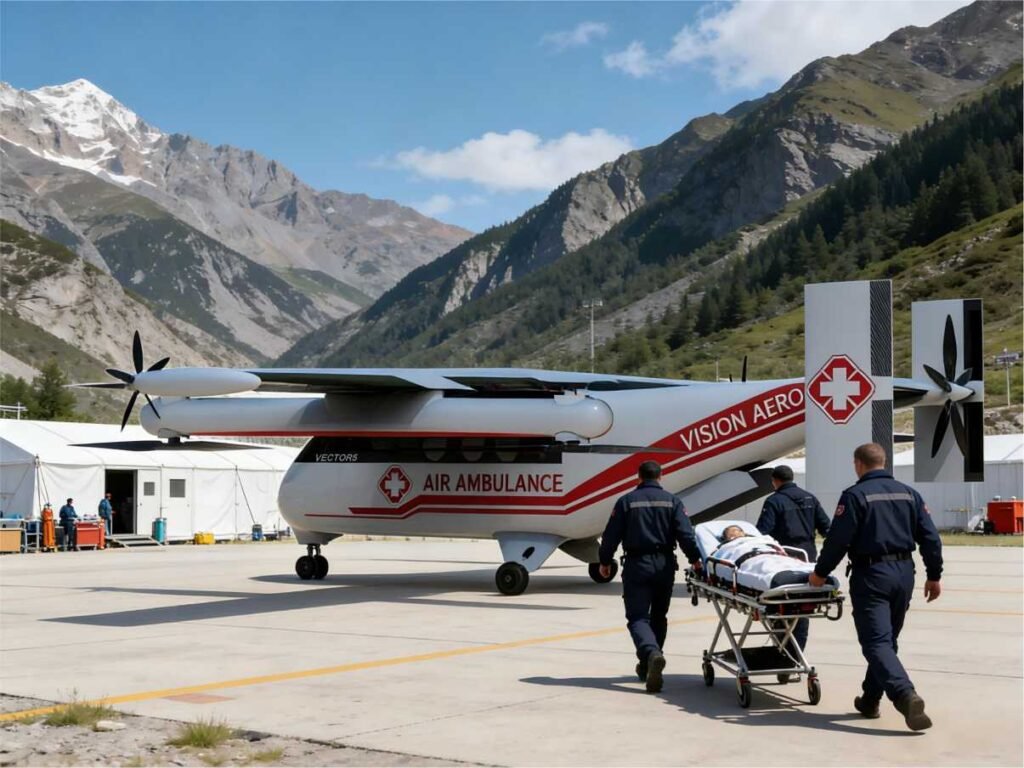
Vision Aero’s product strategy begins with a simple framing: eVTOL is an upgrade to helicopters, not a replacement for everything that flies. To define the right aircraft, Vision Aero studied the best-selling helicopter types over the past 20–30 years and found consistent patterns: EMS/rescue, maritime freight, and business transport; roughly 3-ton MTOW; and 7–9 passengers. Those patterns signal real demand, mature mission scenarios, and willingness to pay. Vector 5 is designed to serve those missions with lower operating costs and higher system efficiency.
Today, the company focuses on two core products: Vector 5, a 3-ton, 7-seat multipurpose eVTOL, and Vector 11, a STOVL fixed-wing aircraft. The definitions come directly from market analysis and a “structural replacement” strategy—replacing aircraft categories where operators face high costs and operational pressure.
The EMS Lens: Designed for Every Minute That Counts
To understand Vision Aero’s “operator-first” thinking, one has to take a look at how Vector 5 is designed for emergency medical services.
Instead of starting from abstract cabin concepts, Vision Aero designed the aircraft around real medevac workflows. Early on, the team measured and planned the cabin based on the actual layout of the Airbus H135. The cabin interior is approximately 3.0 meters long and ~1.6 meters high, enabling standard stretchers plus critical equipment. Payload margin is built into the structure to support medical crews and full equipment loads.
But it’s the systems integration details that reveal the company’s obsession with operational reality. Vector 5 is designed with six 115V/28V dual-voltage power interfaces and a centralized oxygen terminal, supporting the simultaneous operation of multiple medical devices. To cut response time where it counts, Vision Aero says it is currently the only aircraft in its class adopting a tailgate design; combined with a four-point stretcher quick-lock system, standard stretcher loading can be completed in about 15 seconds.
In other words, the aircraft isn’t just “capable of EMS.” It is shaped by the sequence of an EMS mission—arrival, loading, equipment power-up, oxygen integration, and fast turnaround.
Vision Aero’s Priority Route
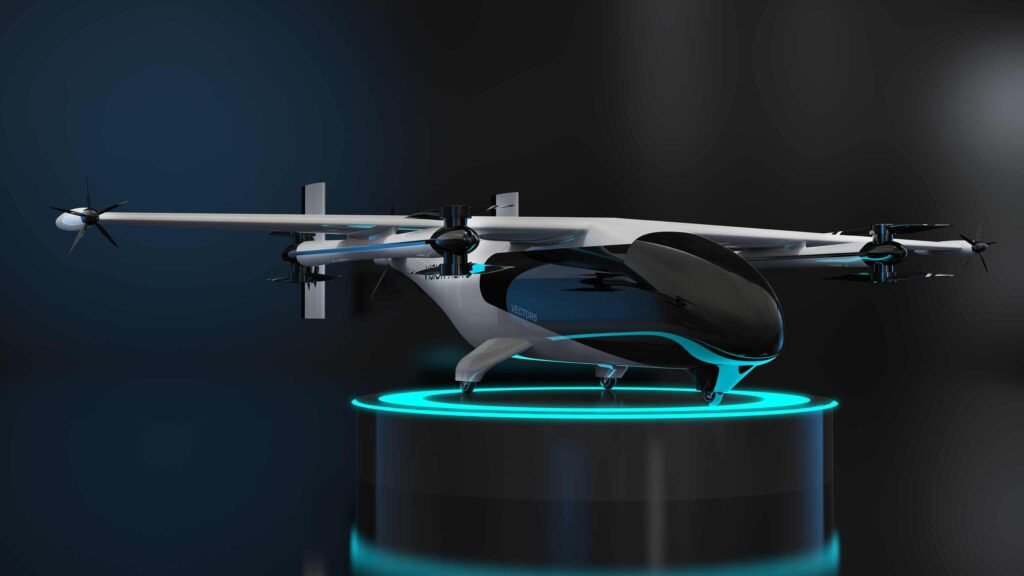
Vision Aero sees Urban Air Mobility (UAM), logistics, and emergency medical services as the three core directions of the low-altitude economy. However, it does not treat them equally in timing.
Logistics is already highly competitive, so the company focuses on differentiated, high-value, or time-sensitive niches rather than homogeneous competition. EMS, by contrast, has clear demand, strict standards, and strong policy support—and is likely to scale earlier than UAM. That’s why Vision Aero prioritizes EMS: real missions generate the best feedback loop—flight data, mission flow, and equipment interaction—which helps improve safety logic and redundancy before broader UAM adoption.
Clean, Efficient—and Ready for the Real World
Vector 5 is planned in two complementary configurations: fully electric and hybrid-electric/range-extended. Vision Aero positions the two powertrains as a portfolio strategy, not a debate.
The fully electric variant is structurally simpler, helping validate aircraft architecture and mature the design more quickly—suited for shorter, repeatable missions and cleaner operations. The hybrid-electric/range-extended variant builds on that foundation and targets 1000 km-class missions, expanding the operating radius and enabling smoother adoption where infrastructure is mixed.
The current performance targets are explicit: for Vector 5 full-electric, MTOW is 3,180 kg, range is 300 km, cruise speed is 250 km/h, and size is 15 × 9.4 × 3.56 m. For the hybrid-electric version, MTOW is 3,180 kg, range is 1000+ km, cruise speed is 280 km/h, and the size envelope is the same.
Behind those numbers sits a design philosophy that looks beyond first delivery: modularity and open avionics architecture are intended to translate into real operator flexibility—lower maintenance downtime via “replace what’s broken,” lighter training requirements, and a standardized support system—while enabling derivative models to reuse most of the design and supply chain.
The Road Ahead: Evidence, Testing, and Certification
Vision Aero describes its near-term development plan as a standard, conservative aerospace progression: expanded ground testing (propulsion endurance, environmental/thermal, EMI/EMC readiness, and HIL/SIL expansion), structural buildup testing (from coupons to sub-assemblies to full-scale representative structures), systems integration in increasingly aircraft-like environments, and then a staged envelope-expansion flight-test philosophy that builds reliability through repetition.
Certification follows a phased, scenario-based roadmap. The cargo variant Type Certificate application has been accepted by CAAC and is proceeding; Vision Aero expects the cargo TC in 2027 if all goes smoothly. Building on that foundation, the company plans to submit the unmanned variant TC application by the end of 2026 and expects a manned TC in 2028 if progress remains on track.
Leadership That Soars to “Next-Level Heights”
For Peter He, leadership in aviation is not motivational language—it’s a daily discipline. The same lessons that taught him to fly—repeatability, verification, and respect for operational reality—also taught him how to build. The same market clarity that guided aircraft trading—mission profiles, willingness to pay, and operator pain points—now guides product definition.
That combination is what Vision Aero is betting on: not a race for the flashiest concept, but a steady march toward aircraft that can be certified, manufactured, and operated reliably—starting with the missions where the value is undeniable, especially emergency response—then expanding outward as evidence and experience accumulate.
Vision Aero states that the future of advanced air mobility will be built the aviation way—one verifiable step at a time.
Company Name: Vision Aero Technology Ltd
Founder: Wei He (Peter He)
Website: www.visionaero.cn