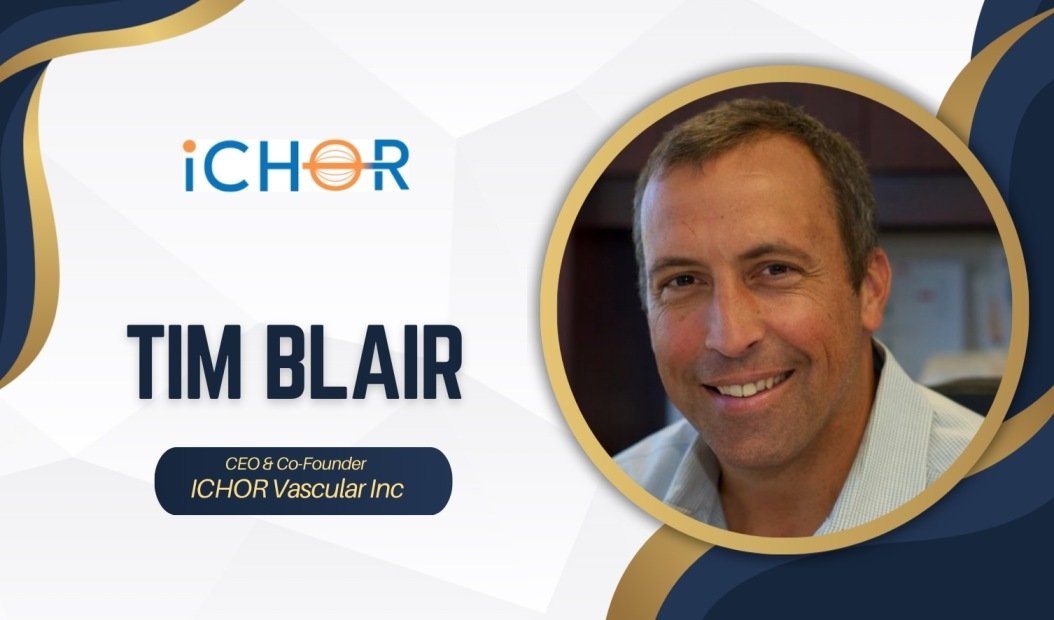
In the ever-evolving world of medical devices, iCHOR stands out with its unique, one-of-a-kind solution designed to address critical issues in peripheral vascular disease: thrombectomy. Tim Blair, CEO of iCHOR, explains that their peripheral platform technologies focus on proven mechanisms of action that replicate the parameters of a surgical thrombectomy. However, this treatment is entirely non-surgical, easy to use, and more cost-effective than today’s options.

Evolution of the Fogarty Sweep into iCHOR’s Non-Surgical Fogarty
To understand the revolution behind iCHOR’s reimagined medical procedure, it is helpful to revisit foundational methods and their evolution over time. Dr. Thomas J. Fogarty, then a surgical technician, invented the surgical embolectomy balloon in 1959 after being challenged by Dr. Jack Cranley to develop a better method for removing clots than the standard open procedures.
The first Fogarty balloon was used in peripheral arteries in the early 1960s, and a decade later the Fogarty balloon catheter was patented. It is important to understand that in the 1960s the bigger the incisions, the better the surgeon was considered. That said, many surgeons naturally questioned the invention due to its apparent simplicity. Nevertheless, Dr. Fogarty continued producing the tools by hand and sharing them with colleagues. He later collaborated with engineer Lowell Edwards to refine and manufacture the product at scale.
The Fogarty balloon went on to become one of the most valuable surgical tools for vascular surgeons treating vascular clots—from fresh acute clots to adherent thrombus. Its enduring success was built on simplicity, a consistent mechanism of action, and predictable results.
Fast forward to 2025, iCHOR Vascular adopted those same principles of simplicity, consistency, and predictability to deliver advanced endovascular solutions. The company reinvented the surgical Fogarty sweep as a percutaneous, fully non-surgical procedure designed to safely and effectively remove vascular occlusions while addressing the shortcomings of current therapies.
While the traditional Fogarty sweep requires open surgical access with a balloon catheter to clear blocked arteries or veins, iCHOR’s approach is entirely percutaneous (through the skin). By transforming a surgical technique into a minimally invasive endovascular procedure, iCHOR aims to eliminate surgical and drug-related complications, reduce ICU stays, eliminate blood loss, reduce procedure time, and significantly lower the costs associated with complex thrombectomy treatment algorithms—achieving simplicity without compromise.
Shortcomings of Existing Solutions

Traditional procedures are often highly invasive or complicated, leading to compromises such as significant blood loss, site bleeding complications, vessel damage, and prolonged recovery times. Current peripheral thrombectomy tools force critical trade-offs that limit both safety and efficacy.
Many platforms compound these issues with complex setups requiring company representatives, additional tubing, and ancillary equipment—adding expense and procedural risk without measurable improvements in outcomes.
As the industry moves toward less invasive tools such as aspiration technologies—borrowed from stroke and pulmonary embolism interventions—they often result in significant blood loss and distal embolization. Aspiration for peripheral vascular disease is not always optimal for lengthy organized thrombus that is attached to vessel walls. What serves well in stroke treatment does not always translate to optimal solutions in the lower extremities.
Metal draggers, typically constructed from steel or nitinol, scrape along the endothelium and often produce vessel trauma, scarring, inflammation, necrosis, wall thickening, and re-thrombosis—issues amplified across the long treatment zones common in peripheral disease. These represent significant compromises in clot removal.
Lytic therapy, adapted from coronary and neurovascular emergencies, carries significant intracranial and gastrointestinal bleeding risks. It is largely ineffective against chronic or aged clots and increases costs due to expensive drugs and mandatory ICU monitoring. The use of lytics is declining worldwide as the effectiveness of mechanical options improves—the same trend seen about 10 years ago in stroke treatment.
iCHOR’s technology is built on a proven endovascular mechanism of action, delivering procedures that are safer, faster, less traumatic, and more efficient for healthcare providers and healthcare systems.
No-Compromise Design Philosophy
iCHOR designed the iSWEEP Mechanical Thrombectomy System exclusively for peripheral vascular occlusions, addressing the distinct anatomical and morphological challenges of lower extremity disease rather than adapting stroke or coronary devices for use outside the brain or heart.
The “aha” moment for the iCHOR Vascular team came while evaluating various thrombectomy tools in the preclinical setting. Various aspiration tools, maceration tools, Archimedes screws, and metal dragging tools were all compared to the predicate device: the surgical Fogarty balloon. Not a single mechanism of action (MoA) could outperform the balloon sweep in clot removal and vessel integrity.
The team jokingly said, “Someone should just build a percutaneous Fogarty.” So they did.
Building on the 60-year success of the Fogarty balloon embolectomy, iCHOR transformed the concept into a simple, fully catheter-based platform that eliminates conventional trade-offs. The system integrates a control sheath, a retrievable funnel-shaped guide catheter, and a compliant balloon catheter. The funnel is positioned proximal to the thrombus, flow is arrested, and the balloon performs a wall-to-wall sweep, capturing the clot into the funnel while maintaining continuous sheath and wire access.
This delivers surgical-level efficacy without open surgery, general anesthesia, or thrombolytics, enhanced by fluoroscopic control and vessel-adaptive compliance that rigid metal or aspiration-based devices cannot replicate.
iSWEEP Solutions: iART & iDVT
The iSWEEP family includes two devices:
- The 7F iART system for peripheral arterial clot removal
- The 14F iDVT system for venous clot removal
Both systems share three integrated components:
- A control sheath for proximal flow arrest and embolic protection
- A nitinol funnel-shaped guide catheter for maximal thrombus capture
- A highly compliant balloon catheter ensuring circumferential wall contact with minimal vessel or valve trauma
This single-kit platform treats vessel diameters of 2–10 mm (arterial) and 6–18 mm (venous) while eliminating the blood loss and vessel damage often associated with aspiration or rigid metal-dragging equipment.
Key Benefits
- Non-surgical, lytic-free therapy reducing length of stay
- Proximal and distal protection minimizing embolization
- Compliant sweep preserving endothelium and valves
- Minimal estimated blood loss (EBL)
- Single disposable kit with no capital equipment required — simply open and go
- Seamless integration into standard endovascular workflows
Clinical Evidence
7F iART (25-patient Limited Market Release)
- 100% technical success across acute limb ischemia, organized thrombus, embolic occlusions, SFA stents/grafts, and post-atherectomy debris (above and below the knee)
- No device-related adverse events
- Enabled follow-on angioplasty and stenting using the same system
14F iDVT (60-patient Multi-Center Study)
- 100% technical success in venous diameters: 9–20 mm
- Thrombus length treated: 2–40 cm (mean 21.4 cm)
- Mean residual thrombus: <10%
- No significant blood loss
- Average procedure time: 31 minutes
- Mean passes: 4.1
- 64% treated with iCHOR + PTA
- 18% treated with iCHOR + PTA + stenting
A True No-Compromise Outcome
iSWEEP delivers surgical-level Fogarty efficacy through an endovascular approach—achieving high clot removal, no vessel damage, no blood loss, no embolic issues, and a simplified workflow—positioning it as a potential new standard for peripheral thrombectomy without having to wait for a salesperson to arrive.
Ease of Use & Workflow Integration
iCHOR is designed for efficiency and ease of use. The system integrates seamlessly into existing clinical environments without additional equipment or complex setup requirements. Healthcare providers can adopt the platform with minimal training, streamlining thrombectomy procedures—even during middle-of-the-night emergencies.
Dr. Troy Long, inventor and co-founder of iCHOR, explains that the company incorporated intuitive interventional elements into a proven surgical technique. The goal is to ensure even low-volume users can quickly understand and effectively use the system.
Redefining Health Economics
With healthcare costs continuing to rise, hospitals face mounting pressure to manage budgets efficiently. iCHOR offers a cost-conscious thrombectomy solution that addresses the escalating financial burden of peripheral vascular disease.
Its simplified, minimally invasive approach reduces procedural time, costs, and patient recovery times. In time, many of these procedures will move into Ambulatory Surgery Centers (ASCs) and Office-Based Labs (OBLs) where iCHOR is already ideally positioned. These same economics make iCHOR’s products compelling globally, where price points are a much larger driver of adoption.
Regulatory Approach & FDA Engagement
Navigating the regulatory landscape is a major challenge for any medical device company. iCHOR has taken a proactive and collaborative approach, working closely with the FDA to ensure safety and efficacy through rigorous testing and clinical evaluation.
The company successfully advanced two products through the U.S. FDA regulatory pathway and initiated a Limited Market Release (LMR) to generate real-world validation and clinical feedback. This strategy enables continuous refinement and optimization of the technology while ensuring regulatory compliance and market readiness.
iCHOR is currently working on a third platform of the iSWEEP line specifically designed for dialysis fistulae and grafts.
iCHOR’s Vision for the Future
Following recent 510(k) U.S. market clearance, iCHOR is focused on expanding real-world adoption and gathering clinical feedback to further optimize its platform.
The primary objective remains clear: meeting the needs of healthcare providers while improving patient outcomes.
Additional milestones include advancing the platform into dialysis applications, progressing through Series A2 financing, and preparing for broader sales and distribution initiatives.
Investing with iCHOR
Backed by an experienced board and leadership team, iCHOR fosters a culture centered on innovation, efficiency, diversity, and significant patient impact.
The company welcomes strategic discussions with investors aligned with its mission to improve vascular care. iCHOR is open to structured funding opportunities that support clinical evidence development, sales and marketing expansion, and further platform advancement.
iCHOR Improves Lives, One Patient at a Time
Peripheral vascular occlusions present a serious burden for both patients and healthcare systems. With fewer complications, minimal invasiveness, and meaningful cost reductions, iCHOR is reshaping thrombectomy through a practical and scalable solution that aims to democratize peripheral thrombectomy.
Tim Blair, CEO of iCHOR, states:
“We built the iCHOR reperfusion system to treat peripheral vascular issues more efficiently. A single packaged system that is completely intuitive and requires no capital equipment enables treatment in non-hospital settings such as office-based labs and ambulatory surgery centers. This same philosophy of efficiency and simplicity applies globally, where cost considerations are even more significant drivers of care.”
The Force Behind the Expertise
iCHOR is led by a seasoned executive team with more than 100 years of combined industry experience.
Timothy Blair, Chief Executive Officer, brings over 30 years of sales and marketing leadership along with a decade of clinical research experience. Troy Long, MD, inventor and Chief Medical Officer, is fellowship-trained in vascular interventional radiology and contributes deep clinical expertise and innovation. Craig Berky, Chief Operating Officer, offers more than 30 years of experience in research and development, engineering, and manufacturing operations.
This multidisciplinary expertise across sales, marketing, engineering, manufacturing, regulatory affairs, and clinical development positions iCHOR to navigate the complexities of medical device development while advancing its mission to revolutionize peripheral thrombectomy.
Company Name: ICHOR Vascular Inc
CEO & Co-Founder : TIM BLAIR
Website: www.ichorvascular.com